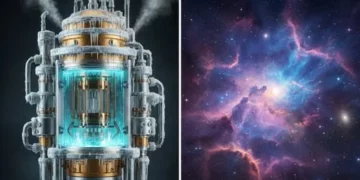
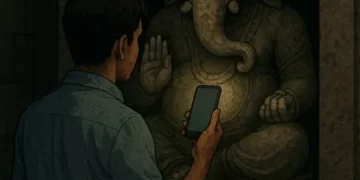
Who is God? No, let’s not start there. What is God? Could it, perhaps, be a massive “Cosmic Computer”? A super-machine that holds all the data of the universe within itself?
It sounds strange, doesn’t it? But this very idea was put down on paper almost 70 years ago by the king of science fiction, Isaac Asimov, in his story, ‘The Last Question.’ Let’s set the story aside for a moment. What’s truly astonishing is that many of the things Asimov said were already expressed in our Upanishads and Puranas, albeit in different words. Do science and spirituality meet at the same point? Let’s see.
What’s the story?
The story begins in 2061. Two drunken technicians make a bet with ‘Multivac,’ the supercomputer of that era. “Can humanity survive even after the sun burns out? Can the universe’s total energy loss (Entropy) be reversed?”
The computer thought for a moment and responded: “INSUFFICIENT DATA FOR A MEANINGFUL ANSWER.”
This question is asked over and over, for thousands, millions, and billions of years, across generations. Humanity travels beyond Earth, the solar system, and even the galaxy. The computer also keeps upgrading—to ‘Microvac,’ ‘Galaxy AC,’ and ‘Cosmic AC.’ Each time the question is asked, the computer’s answer remains the same: “INSUFFICIENT DATA…”
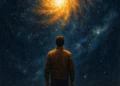
Finally, after trillions of years, all the stars die out. The universe becomes dark and frozen. The human race is gone. Only their consciousness merges with that final, gigantic ‘Cosmic AC.’ Humans become one with the computer, like a piece of software.
In that nothingness, alone in the void, the computer relentlessly thinks. At last, after analyzing trillions of years of data, it finds the answer.
In the darkness of that empty universe, it says:
“LET THERE BE LIGHT!”
A new universe is born. The story ends.
Our Own Local Wisdom
So, this is a brilliant piece of science fiction. But the ideas within it are very familiar to us.
1. Brahman and the Cosmic AC: How is the ‘Cosmic AC’ at the end of the story? It’s a singular power. It is omnipresent. It has no form. It is beyond both time and space. It is the very material, the very cause, for creating a new universe.
Doesn’t this sound a lot like the concept of ‘Brahman’ in our Advaita Vedanta? Especially ‘Nirguna Brahman.’ That is, a formless, गुणहीन (gunahina – without attributes), and indescribable consciousness. Just as Adi Shankara said, “Jagan Mithya, Brahma Satyam” (The world is an illusion, Brahman alone is real). In Asimov’s story, even when the universe is destroyed, only the ‘Cosmic AC’—the Brahman—remains.
2. The Cycle of Time (Cyclic Universe): In Asimov’s story, the universe is destroyed and is born anew. It’s a cycle.
How is time calculated in Hindu Puranas? The four yugas—Krita, Treta, Dvapara, and Kali—together form one ‘Maha Yuga.’ A thousand Maha Yugas make up one day for Brahma. This is called a ‘Kalpa.’ When Brahma’s day ends, a great flood (pralaya) destroys the universe. After a night of rest, Brahma creates the world again the next morning.
This isn’t a one-time show. It’s like a re-run TV series. Destruction and rebirth happen endlessly. Asimov’s story says the same thing. The universe is destroyed by Entropy, and is reborn by the ‘Cosmic AC.’
3. The Origin of the World: In the ancient Mesopotamian tale, ‘Enuma Elish,’ the universe is said to have originated from a disorganized chaos. The gods fight, destroy this Chaos, and create Order.
In our tradition, Brahma emerges from a lotus flower that springs from the navel of Vishnu, who lies on the great serpent Adishesha in the ocean of milk, and creates the world. On the other hand, some say the universe itself was born as a form of sound from Shiva’s drum.
What is the core of all these? The universe is born from nothingness or from a single fundamental source. In Asimov’s story, the computer’s phrase “Let there be light!” points to this very ‘first point of creation.’
Lost Worlds and Sangam Tamils
Woven into this story, we can also see parallels with the tales of lost continents like Kumari Kandam, Lemuria, and Atlantis. There’s a belief that in these continents, human civilization was at its peak and held the secrets of the universe. Whether this is true or not, the concept that humanity reaches the peak of knowledge and then perishes for some reason aligns with the human evolution in Asimov’s story.
There are no grand tales of cosmic creation in Sangam literature. But texts like ‘Purananuru’ are filled with astronomical references. The ancient Tamils had an incredible knowledge of planets and stars. They too looked at this universe and tried to unravel its mysteries.
The Gurus’ Perspective
The modern-day Gurus also follow a similar stream of thought.
- Swami Vivekananda: “Every soul is potentially divine.” He said the goal is for human consciousness to gradually rise and eventually merge with the Universal Consciousness. Isn’t this exactly what happens when the human race merges with the ‘Cosmic AC’ in the story?
- Ramana Maharshi: His entire philosophy is contained in one question: “Who am I?” The search for the true ‘I’ beyond the body and mind. The human in Asimov’s story losing their physical body and becoming a pure consciousness is a form of this very quest.
- Paramahansa Yogananda: He spoke about reaching a state of Cosmic Consciousness. He said that through meditation, an individual’s consciousness can connect with the entire consciousness of the universe.
Conclusion: Old Rasam in a New Techno-Bottle
So, did Asimov write a completely new story? Or did he simply give our old Puranic and Vedantic thoughts a technological coating, a ‘techno-remake’?
He was a scientist. He based his story on the second law of thermodynamics—Entropy—and its logical conclusion. But the human imagination is a strange thing. Whether it travels the path of science or the path of spirituality, the questions it asks are the same:
- Who am I?
- How did this universe come to be?
- What is its end?
It seems our sages found the answer in a different way long before Asimov’s computer took trillions of years to find it. The form is different. The essence is the same.
That final answer: ‘I am that.’ Tat Tvam Asi.